Welcome to OnBoard™ IoT Security
Overview
OnBoard™ IoT Security (OBIS) is an authorization-based security platform designed to address the fundamental challenge of scaling secure device provisioning globally while retaining OEM control over cryptographic trust. It is built to protect the integrity, confidentiality, and authorized use of product digital assets. OBIS is delivered as a cloud platform with flexible deployment options to meet different data residency and operational requirements. It is not a PKI service or a factory security system—it is a security control plane that governs how product digital assets may be used across the device manufacturing lifecycle.
Built on an authorization-based model with centralized control and distributed execution, OBIS enables OEMs to govern all product digital assets and every security-critical operation across any number of factories and partners, without ever exposing sensitive material.
This architecture enables OEMs to:
- onboard new factories
- switch production partners or silicon suppliers
- scale across regions
All while maintaining centralized control and monitoring. Rather than requiring factories to be trustworthy, OBIS makes trust unnecessary by design.
Product architecture
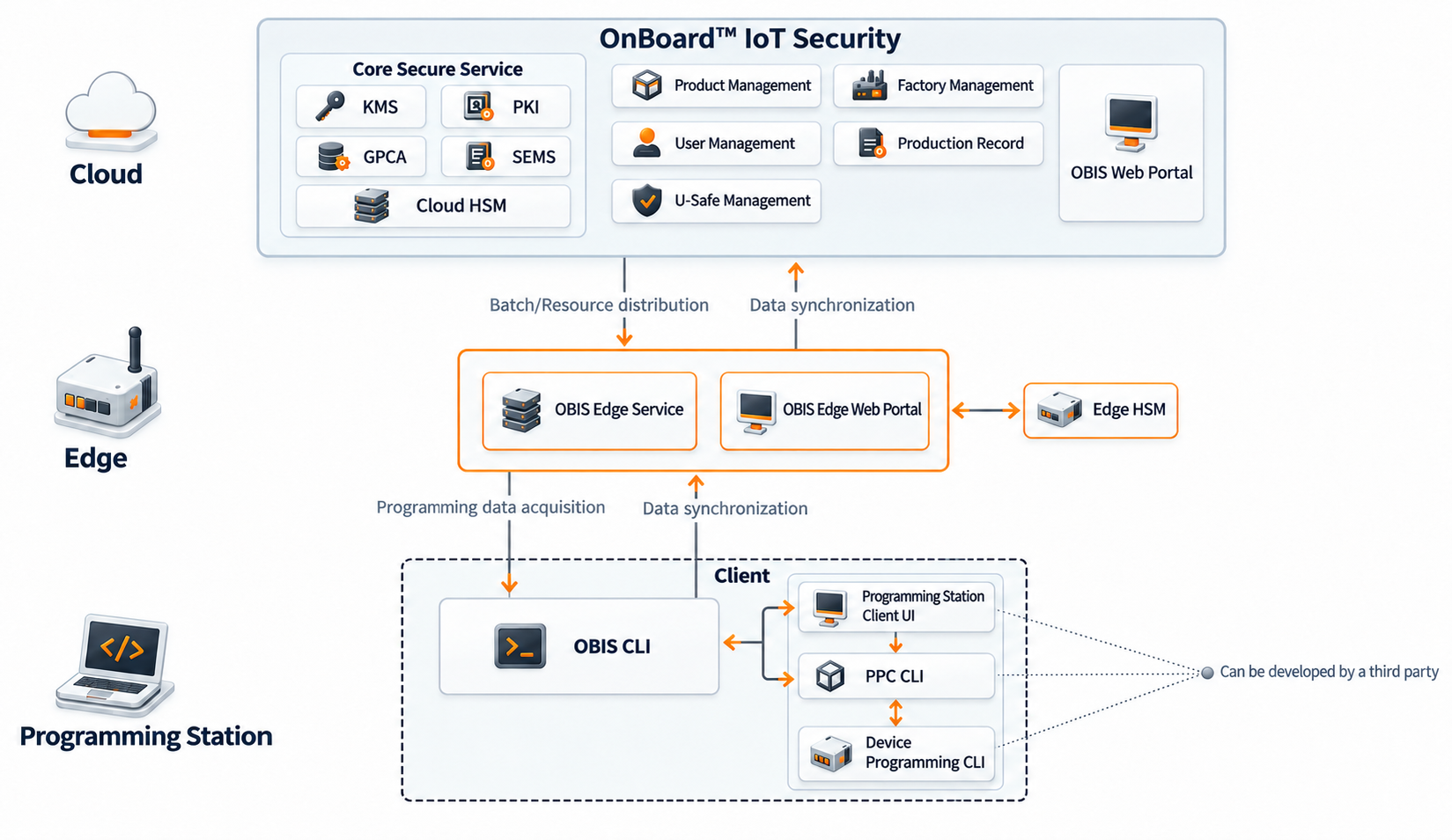
OBIS consists of three main components: Cloud, Edge, and Programming Station:
| Components | Description |
|---|---|
| Cloud | OnBoard™ IoT Security includes:
|
| Edge |
|
| Programming Station | OBIS CLI (Command Line Interface), Programming Station Client UI, PPC (Programming Process Control) CLI, and Device Programming CLI are provided by the Client, which are used for executing device programming. |
Core features
-
Collaborative Digital Asset Management
Configures and manages digital assets with the "Product" as the central unit, OBIS supports multi-role collaboration such as OEM and ODM. Role-based access control ensures the security of digital assets. Through product configuration and task management, OBIS enables full-process collaboration from modeling to pre-mass production. The main functionalities include:
- Product modeling: Define and maintain basic product information and parameters.
- Team collaboration: Invite multiple participants, including cross-tenant members, to collaboratively manage products.
- Resource management: Unified management of resources such as chip parameters, matter configurations, firmware, certificates, and keys.
- Production programming management: Standardize each production programming task through version control and batch management.
-
Secure Provisioning
Provides an end-to-end secure programming process from Cloud configuration to Edge execution, covering key writing, certificate generation, device programming, secure boot, secure debugging, and other critical steps, ensuring that each device's parameters and data are trustworthy and secure during the production phase.
-
Device Lifecycle Management
Supports continuous management of programmed devices, offering capabilities such as device status monitoring and secure firmware updates, enabling full lifecycle visibility, controllability, and traceability from production to deployment.
-
Security Infrastructure
Provides standard KMS and PKI services, along with GP CA certificate management for GlobalPlatform SCP11c and SEMS configuration asset management for Secure Elements. By integrating with Cloud HSM, it establishes a unified cryptographic security infrastructure and supports the deployment of distributed security services at the Edge (factory side), ensuring end-to-end security for OBIS.
OBIS Positioning and System Boundary
OBIS provides OEMs with a centralized control plane for product digital assets and authorization management—positioned between upstream silicon manufacturing and downstream device lifecycle management.
-
Upstream: Trust Artifact Ingestion
OBIS can receive trust artifacts generated during semiconductor manufacturing, such as hardware Root of Trust materials or initial device secrets injected by chip vendors. These artifacts are incorporated into the OEM's product security model and managed consistently alongside other product digital assets within OBIS.
-
Manufacturing: Production Batch Execution
OBIS issues explicit Production Batches to OEM-owned or partner-operated factories, defining what may be produced, where, when, and at what scale.
-
Downstream: Trust Artifact Handoff
OBIS collects all production outcomes—including per-device security artifacts and immutable production records—and hands them off to OEM-managed or OEM-authorized device management platforms, enabling secure device onboarding and supporting downstream lifecycle operations.
OBIS is not a factory execution system, a device management platform, or a replacement for MES—it is a centralized product digital asset management and authorization-driven security governance layer—enabling OEMs to coordinate security across all manufacturing partners through a single control plane.
Role classification and permission description
Supports role-based permission management. The current roles are divided into three categories: OBIS roles, product roles, and factory roles. The following six tables describe each role and the corresponding operational permissions.
OBIS roles
OBIS roles are predefined by the system to meet common permission requirements. The following roles can accommodate most usage scenarios, and users can configure one or more roles as needed. For special permission control requirements, please contact Snowball to create corresponding custom roles.
| Roles | Description |
|---|---|
| System Manager | This role has permissions for all roles. |
| Product Manager | This role has permissions to view and operate the Product Management functional pages. |
| Resource Manager | This role has permissions to view and operate the KMS and PKI functional pages. |
| SE Resource Manager | This role has permissions to view and operate the GPCA and SEMS functional pages. |
| Factory Manager | This role has permissions to view and operate the Factory Management functional pages. |
| Normal User | This role has permissions to view all functional pages. |
The following table summarizes the access and operational permissions of each OBIS role across different functions.
| Functions | Permissions | System Manager | Product Manager | Factory Manager | Resource Manager | SE Resource Manager | Normal User |
|---|---|---|---|---|---|---|---|
| Product | Page Access |  | | | |||
| Page Operations | | | |||||
| Factory | Page Access | | | | |||
| Page Operations | | | |||||
| Records | Page Access | | | | | | |
| KMS | Page Access | | | | |||
| Page Operations | | | |||||
| PKI | Page Access | | | | |||
| Page Operations | | | |||||
| GPCA | Page Access | | |||||
| Page Operations | | | |||||
| SEMS | Page Access | | | ||||
| Page Operations | | | |||||
| Account | Page Access | | | ||||
| Page Operations | | ||||||
| Group | Page Access | | | ||||
| Page Operations | | |
Product roles
Product roles are designed to control access and operational permissions of product resources. Users can configure one or more roles as needed.
| Roles | Description |
|---|---|
| Product Owner | This role defaults to the product creator, with full operational permissions for the product. |
| Product Manager | This role has full access to all product operations. |
| Resource Manager | This role has permissions to view the product and manage its resources. |
| Version Manager | This role has permissions to view the product and manage its versions. |
| Batch Manager | This role has permissions to view the product and manage its batches. |
| Member | Default user role, with permission to view the product. |
The following table summarizes the operational permissions of each role for the Product function.
| Functions | Operations | Product Owner | Product Manager | Resource Manager | Version Manager | Batch Manager | Member |
|---|---|---|---|---|---|---|---|
| Product | Configure a product | | | | |||
| Check products | | | | | | | |
| Manage products | | | |||||
| Create a version | | | | ||||
| Check versions | | | | | | | |
| Manage versions | | | | ||||
| Create a batch | | | | ||||
| Check batches | | | | | | | |
| Check programmed devices | | | | | | | |
| Check logs | | | | | | | |
| Manage members | | |
Factory roles
Factory roles are designed to manage and handle factory-related business, and can be configured (local factory & cloud factory by users as needed.
| Role | Description |
|---|---|
| Factory Admin | This role defaults to the factory creator, with full operational permissions for the factory on both Cloud and Edge. |
| Factory Manager | This role has full access to all factory operations on both Cloud and Edge. |
The following table summarizes the operational permissions of the Factory Admin and Factory Manager on both Cloud and Edge.
| Components | Functions | Factory Type | Operations | Factory Admin | Factory Manager |
|---|---|---|---|---|---|
| Cloud | Factory | Local factory & Cloud factory | Create a factory | | |
| Local factory & Cloud factory | Configure and manage factories | | | ||
| Local factory & Cloud factory | Configure and manage programming stations | | | ||
| Cloud factory | Manage batches and assign programming stations | | | ||
| Local factory & Cloud factory | Check factories | | | ||
| Edge | Factory | Local factory | Manage factories | | |
| Station | Local factory | Configure and manage programming stations | | | |
| Batch | Local factory | Manage batches and assign programming stations | | |

 Download User Manual