How to create a key in OnBoard™ IoT Security
This article will guide you on how to create a symmetric and asymmetric key in OnBoard™ IoT Security (OBIS).
Prerequisites
Before getting started, please ensure that you have OBIS role permissions as a System Manager or Resource Manager.
Instructions
After a key is created, it can be selected when configuring Keys for a product.
-
Sign in to OBIS.
-
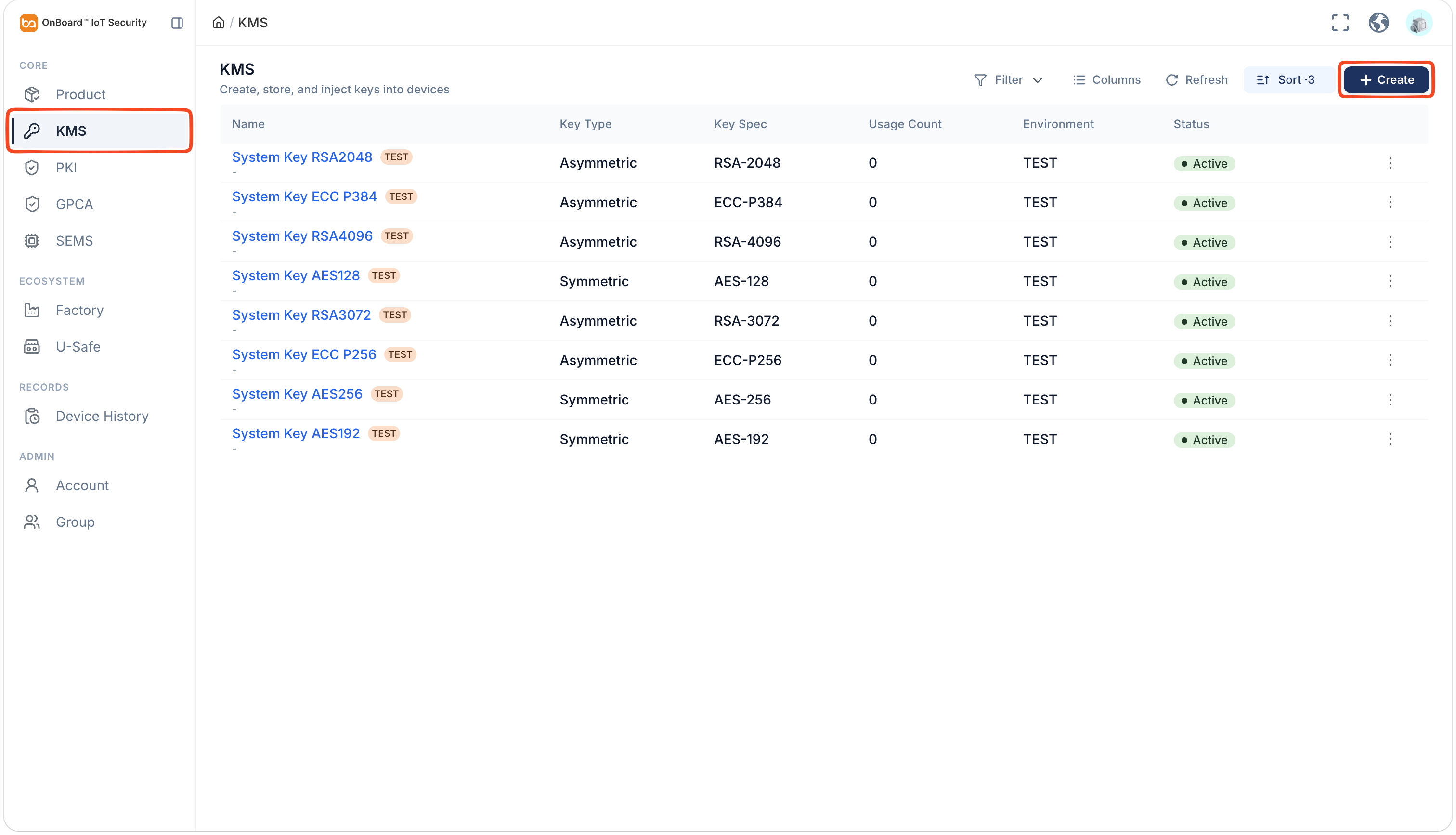
In the Core section of the left menu, click KMS, and then click Create on the KMS page.
Step one: Configure the basic information
In the Basic Info section, select and enter the key basic information.
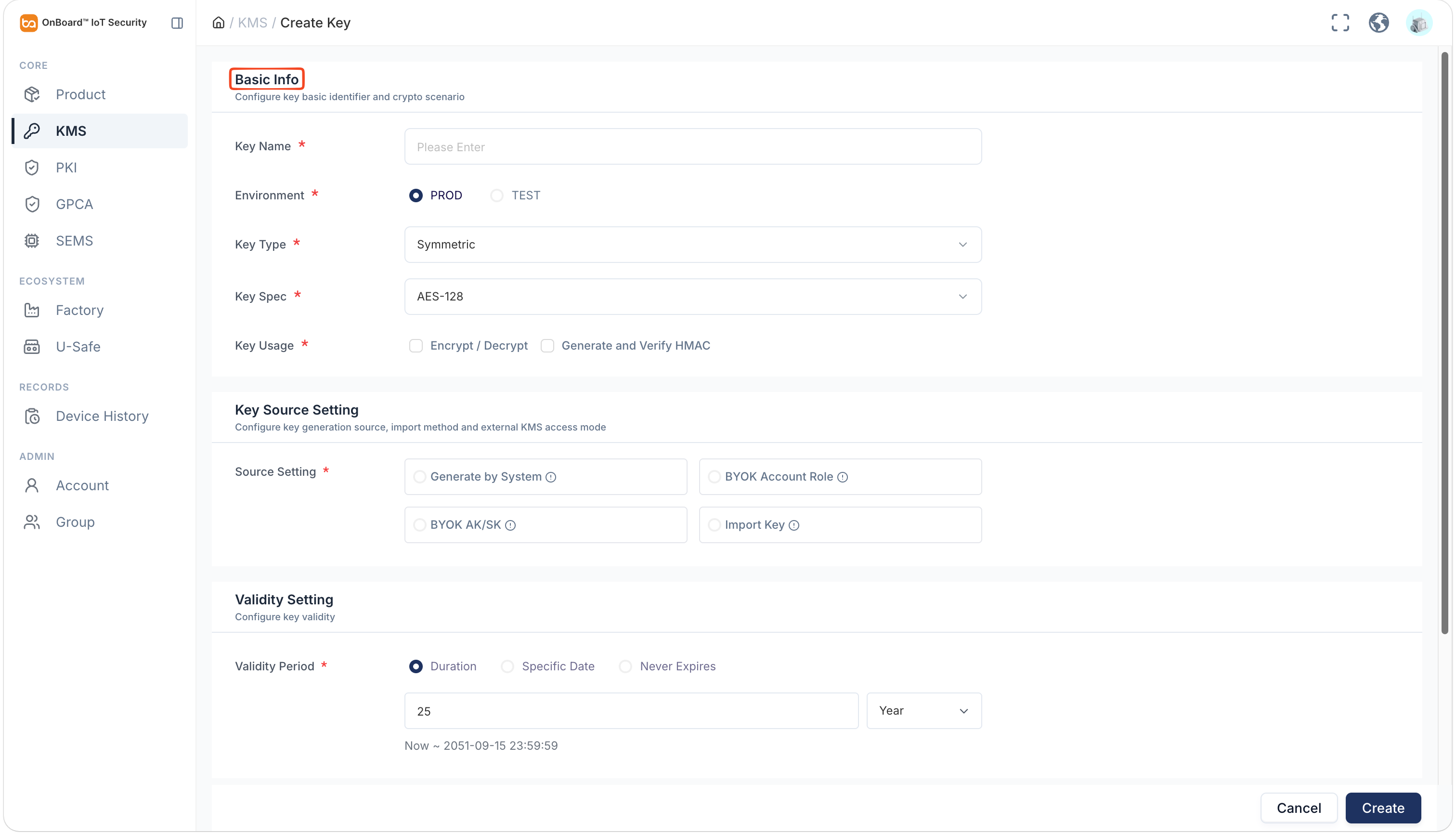
Description of key basic information:
| Information | Mandatory | Description |
|---|---|---|
| Key Name | Yes | The key name must be unique in the same environment. |
| Environment | Yes | Two environments can be selected: PROD and TEST. |
| Key Type | Yes | Two key types can be selected: Symmetric and Asymmetric. |
| Key Spec | Yes | Select encryption algorithms for symmetric and asymmetric keys:
|
| Key Usage | Yes | Limit the operations the key is allowed to perform (multiple selections allowed):
|
Step two: Configure the key source
Symmetric key
- Generated by System
- BYOK Account Role
- BYOK AK/SK
- Import Key
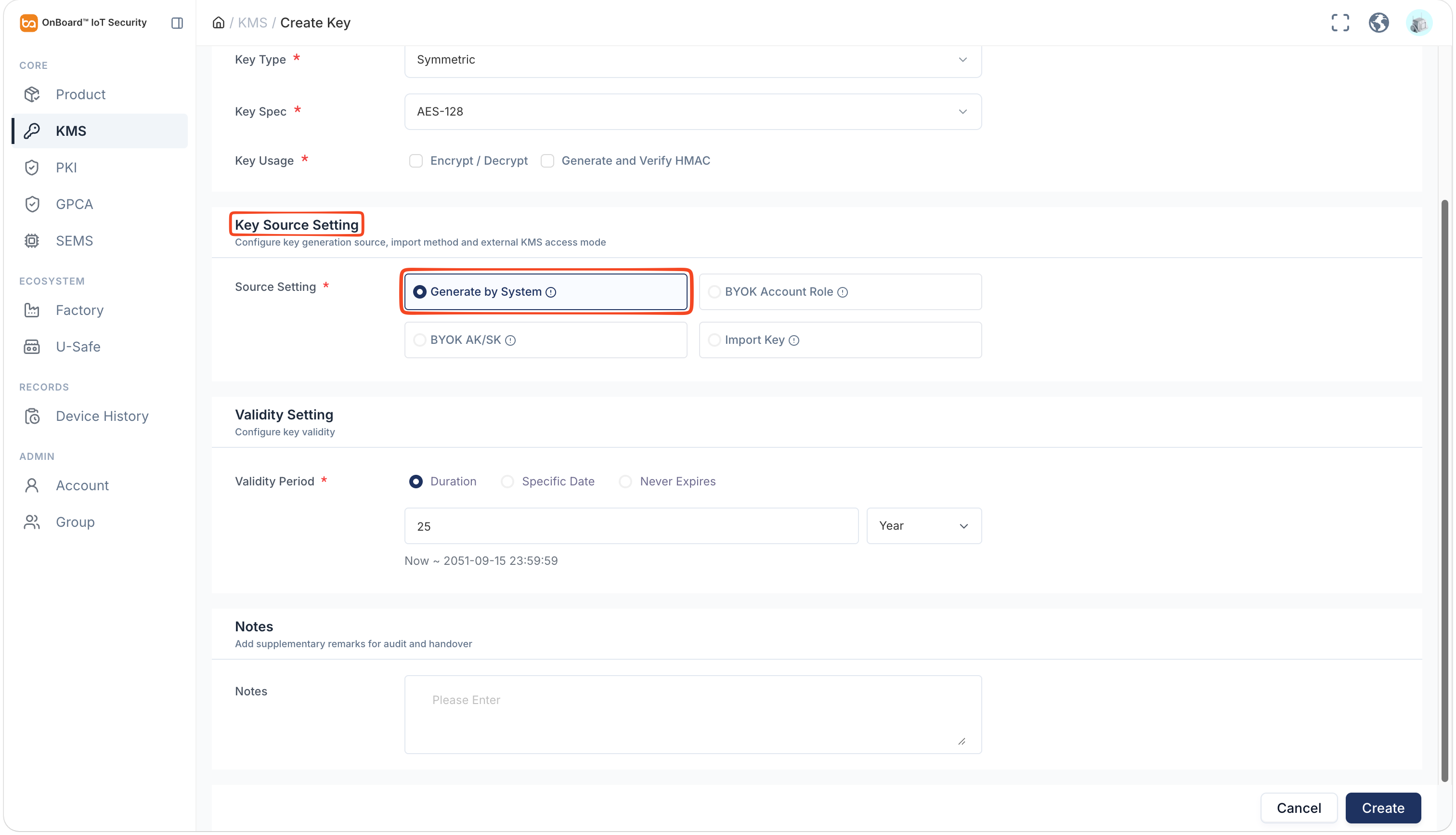
The system securely generates a random key pair inside a Hardware Security Module (HSM).
In the Key Source Setting section, select Generated by System.
Connect to AWS KMS using IAM Role-based access—secure and ideal for cloud-native deployments.
In the Key Source Setting section, select BYOK Account Role, and then enter the key-related information.
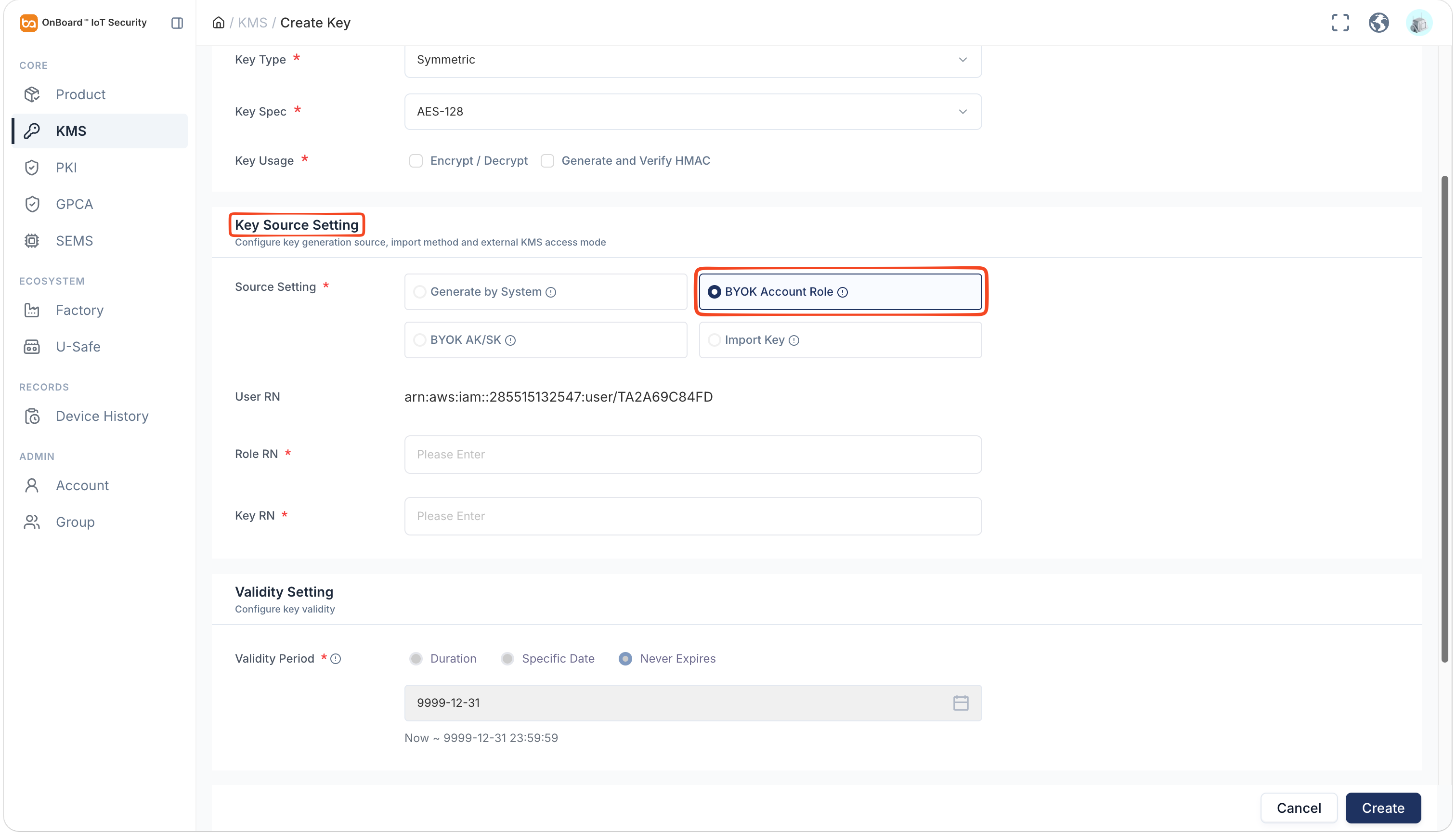
Description of Account Role information:
| Information | Mandatory | Description |
|---|---|---|
| User RN | No | Uniquely identifies a user in AWS IAM (such as an administrator or developer), used for permission assignment and resource access control. |
| Role RN | Yes | Uniquely identifies a role in AWS IAM, used for temporary permission assignment (such as cross-account access for EC2 instances or Lambda functions). |
| Key RN | Yes | Uniquely identifies an encryption key in AWS KMS, used for data encryption and decryption. |
Access external keys from third-party KMS using Access Key and Secret Key credentials.
In the Key Source Setting section, select BYOK AK/SK, and then enter the key-related information.
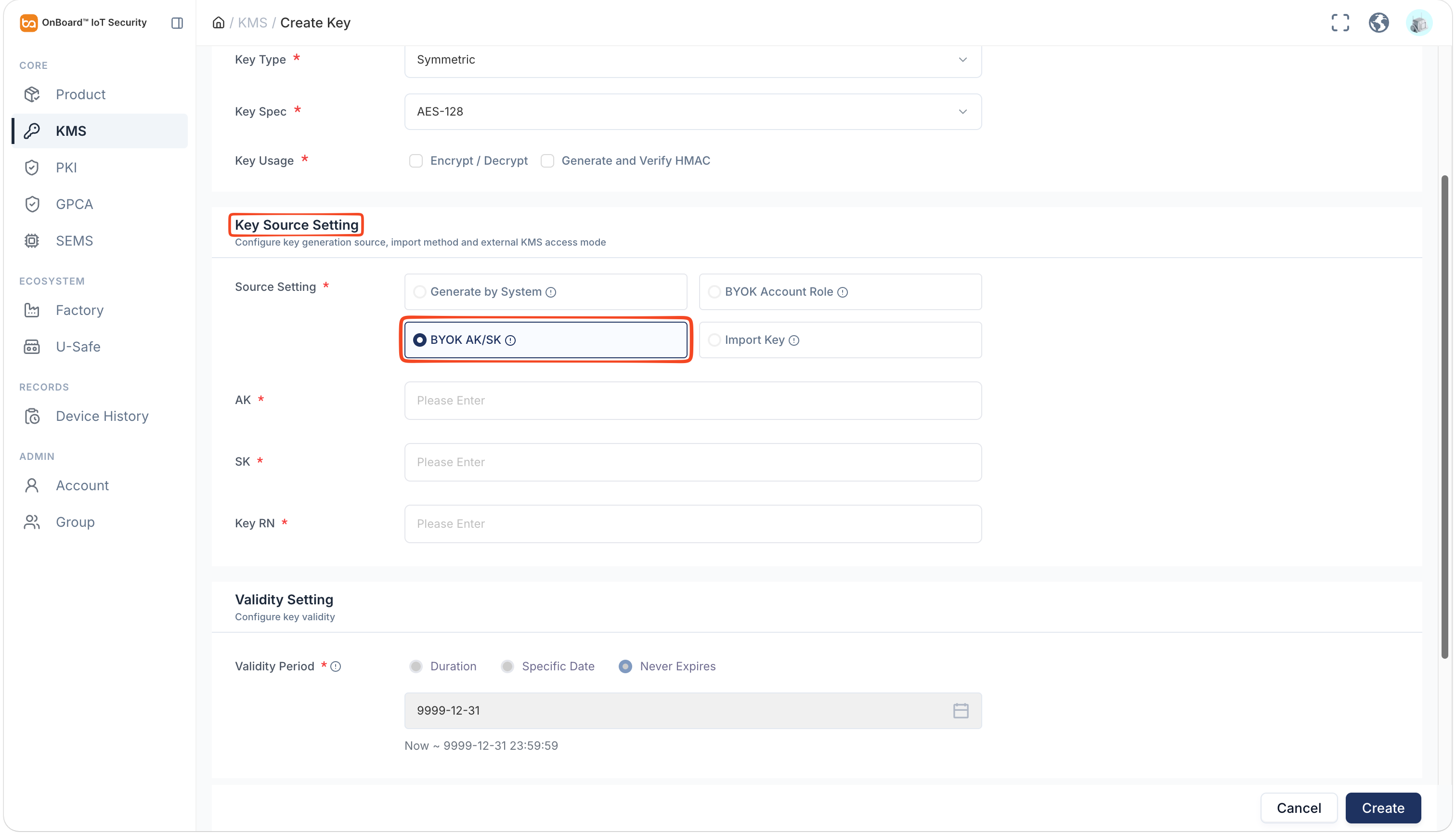
Description of AK/SK information:
| Information | Mandatory | Description |
|---|---|---|
| AK | Yes | AK (Access Key ID):
|
| SK | Yes | SK (Secret Access Key):
|
| Key RN | Yes | ARN (Amazon Resource Name): uniquely identifies an encryption key in AWS KMS, used for data encryption and decryption. |
Manually upload an existing symmetric key generated outside the system.
In the Key Source Setting section, select Import Key. Select the encryption method and key algorithm. Description of Import Key information:
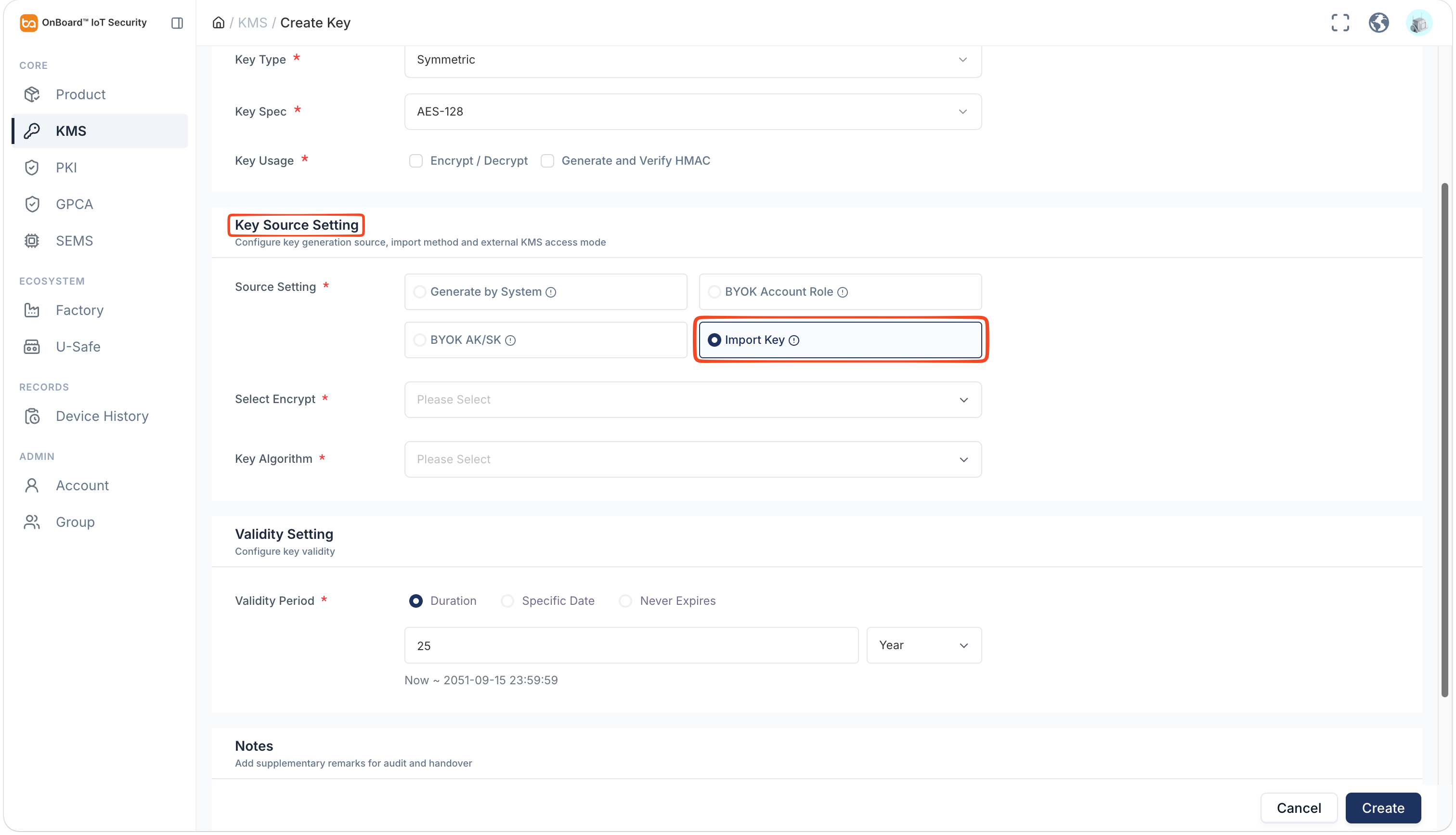
Description of Import Key information:
| Information | Mandatory | Description |
|---|---|---|
| Select Encrypt | Yes | Select the encryption algorithm. Currently, only RSA_2048 is supported, which provides a baseline level of security and is suitable for scenarios such as key encryption and digital signatures. |
| Key Algorithm | Yes | Select the key algorithm:
|
When the key source is Import Key, you need to complete the key encryption configuration after creating the key. Before the key encryption configuration is completed, the key will remain in the Pending status and can't be used.
Key encryption configuration
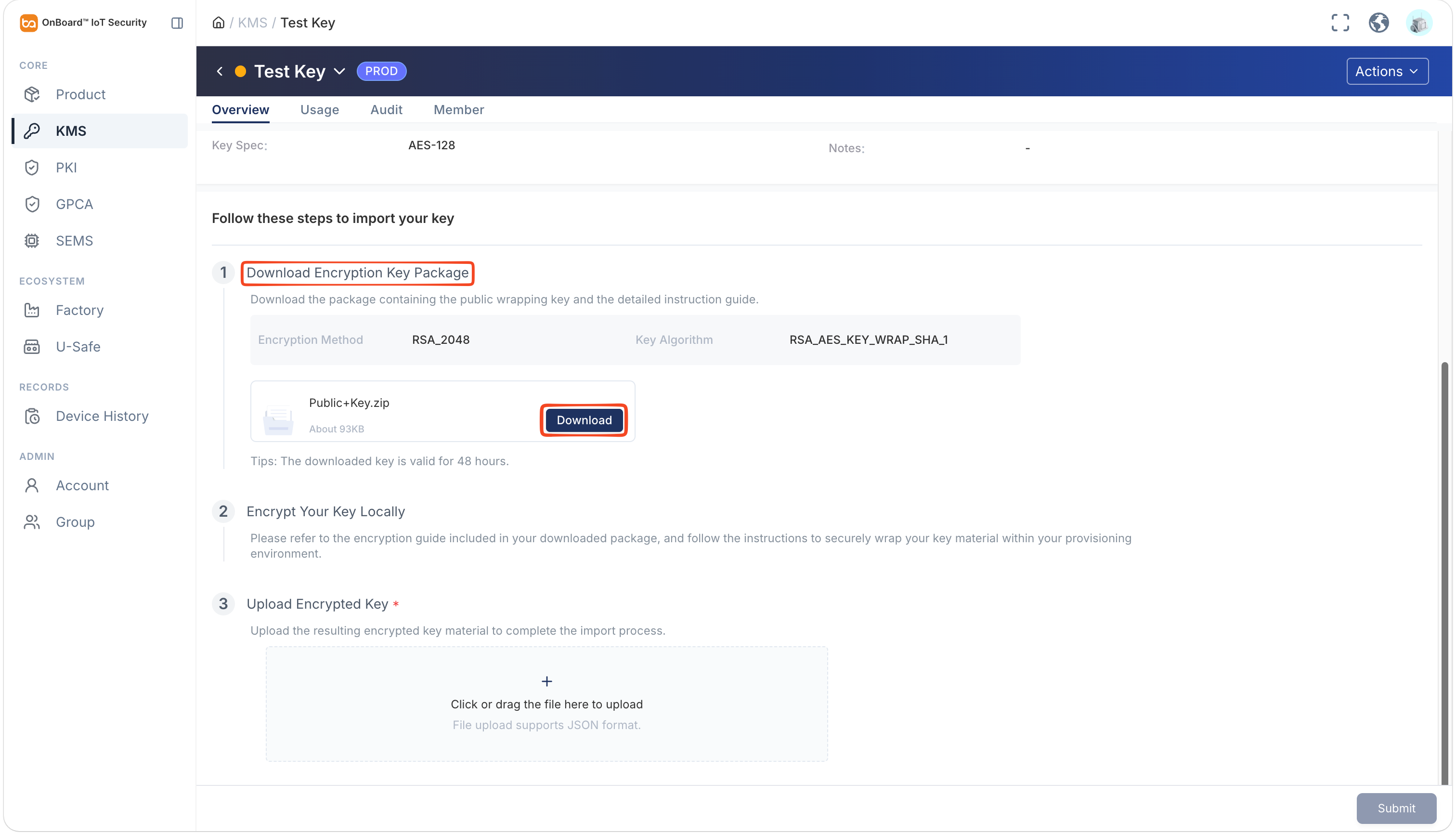
When the key source is Import Key, refer to the following steps to complete the key encryption.
-
On the KMS page, select the corresponding key.
-
Locate the Download Encryption Key Package section on the key page, and then click Download to download the encryption key file.
-
Import the downloaded encryption key into your HSM and use it to encrypt the symmetric key.
-
After the symmetric key is encrypted, select and upload the encrypted key file in .json format in the Upload Encrypted Key section.
-
Click Submit to complete the key encryption configuration, and the key status will change to Active.
Asymmetric key
- Generated by System
- Import Key Pair
- BYOK Account Role
- BYOK AK/SK
- Import Public Key
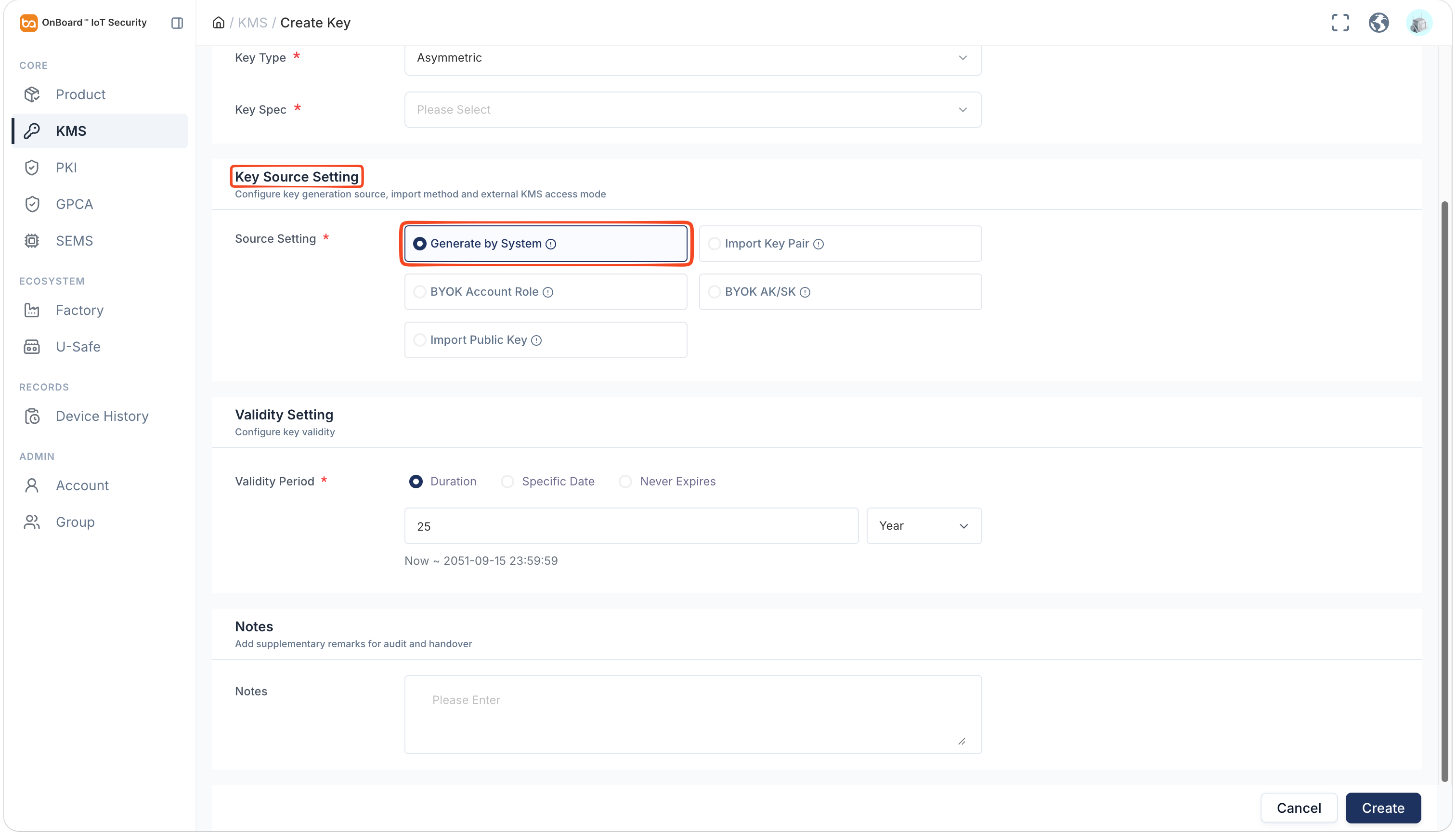
The system securely generates a random key pair inside a Hardware Security Module (HSM).
In the Key Source Setting section, select Generated by System.
Manually upload an existing asymmetric key pair generated outside the system.
In the Key Source Setting section, select Import Key Pair. Then, select the encryption method and key algorithm.
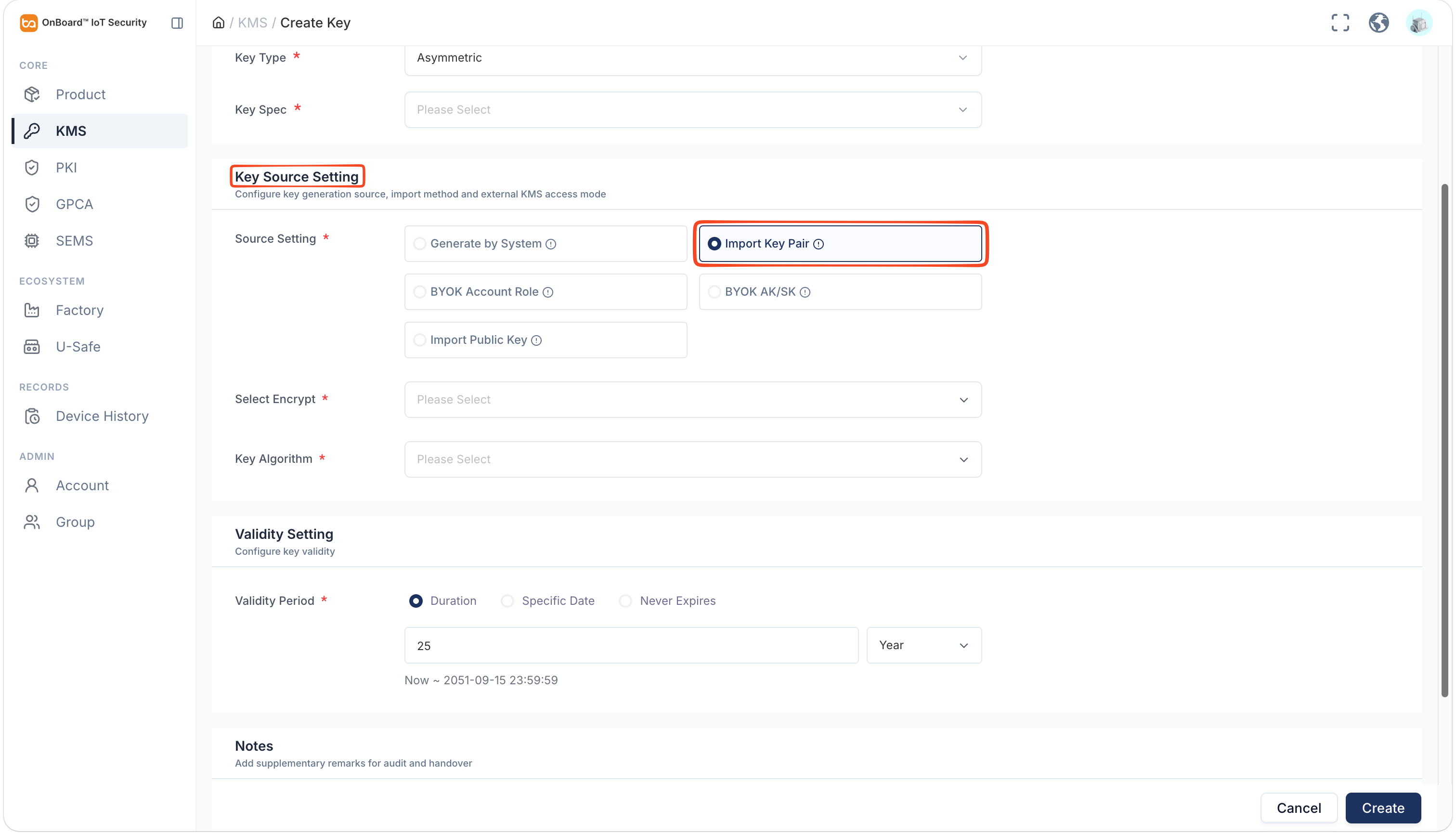
Description of Import Key Pair information:
| Information | Mandatory | Description |
|---|---|---|
| Select Encrypt | Yes | Select the encryption algorithm. Currently, only RSA_2048 is supported, which provides basic security strength and is suitable for scenarios such as key encryption and digital signatures. |
| Key Algorithm | Yes | Select the key algorithm:
|
When the key source is Import Key Pair, you need to complete the key encryption configuration after creating the key. Before the key encryption configuration is completed, the key will remain in the Pending status and can't be used.
Key encryption configuration
When the key source is Import Key Pair, refer to the following steps to complete the key encryption.
-
On the KMS page, select the corresponding key.
-
Locate the Download Encryption Key Package section on the key page, and then click Download to download the encryption key file.
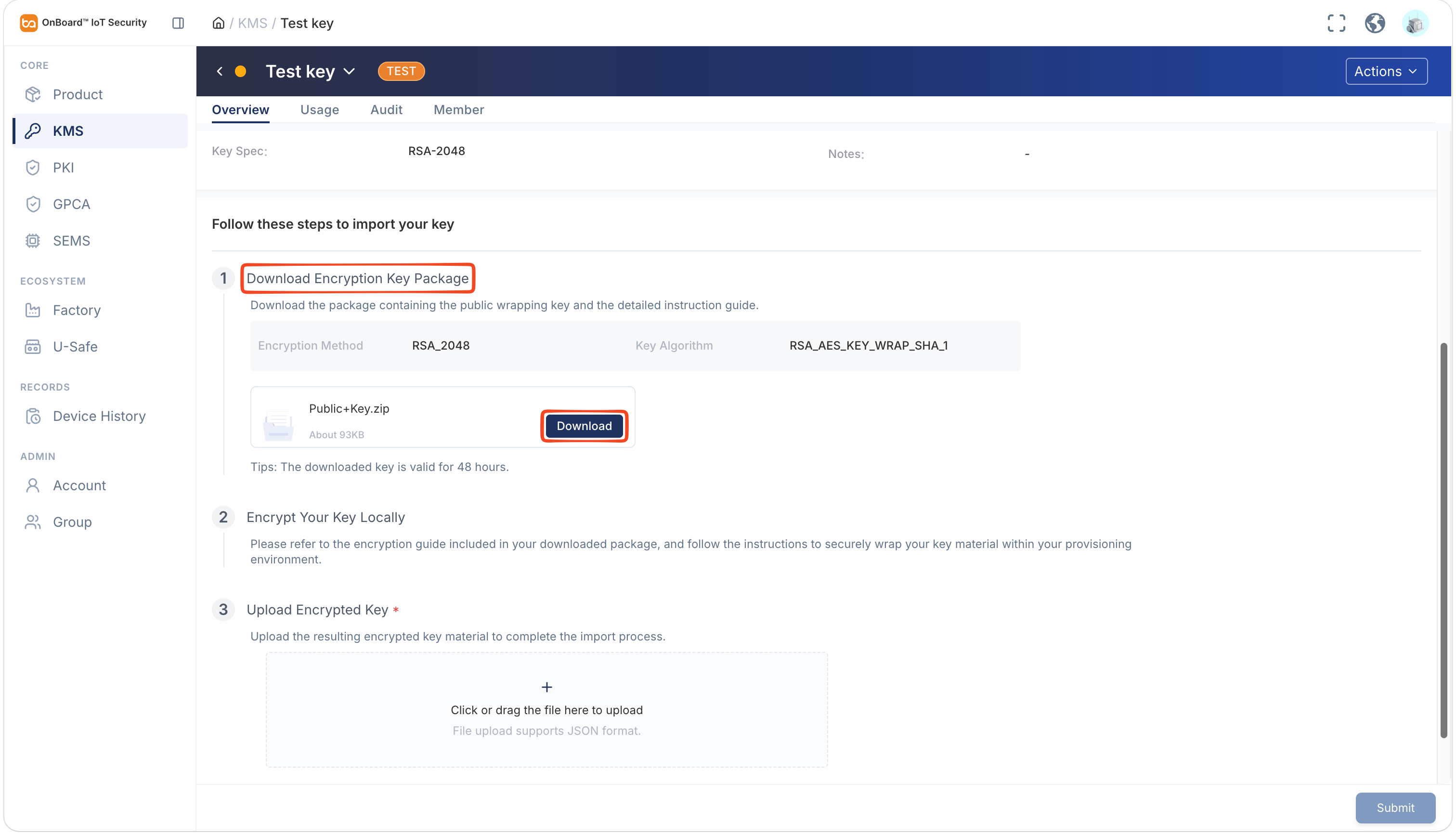
-
Import the downloaded encryption key into your HSM and use it to encrypt the symmetric key.
-
After the symmetric key is encrypted, select and upload the encrypted key file in .json format in the Upload Encrypted Key section.
-
Click Submit to complete the key encryption configuration, and the key status will change to Active.
Connect to AWS KMS using IAM Role-based access—secure and ideal for cloud-native deployments.
In the Key Source Setting section, select BYOK Account Role, and then enter the key-related information.
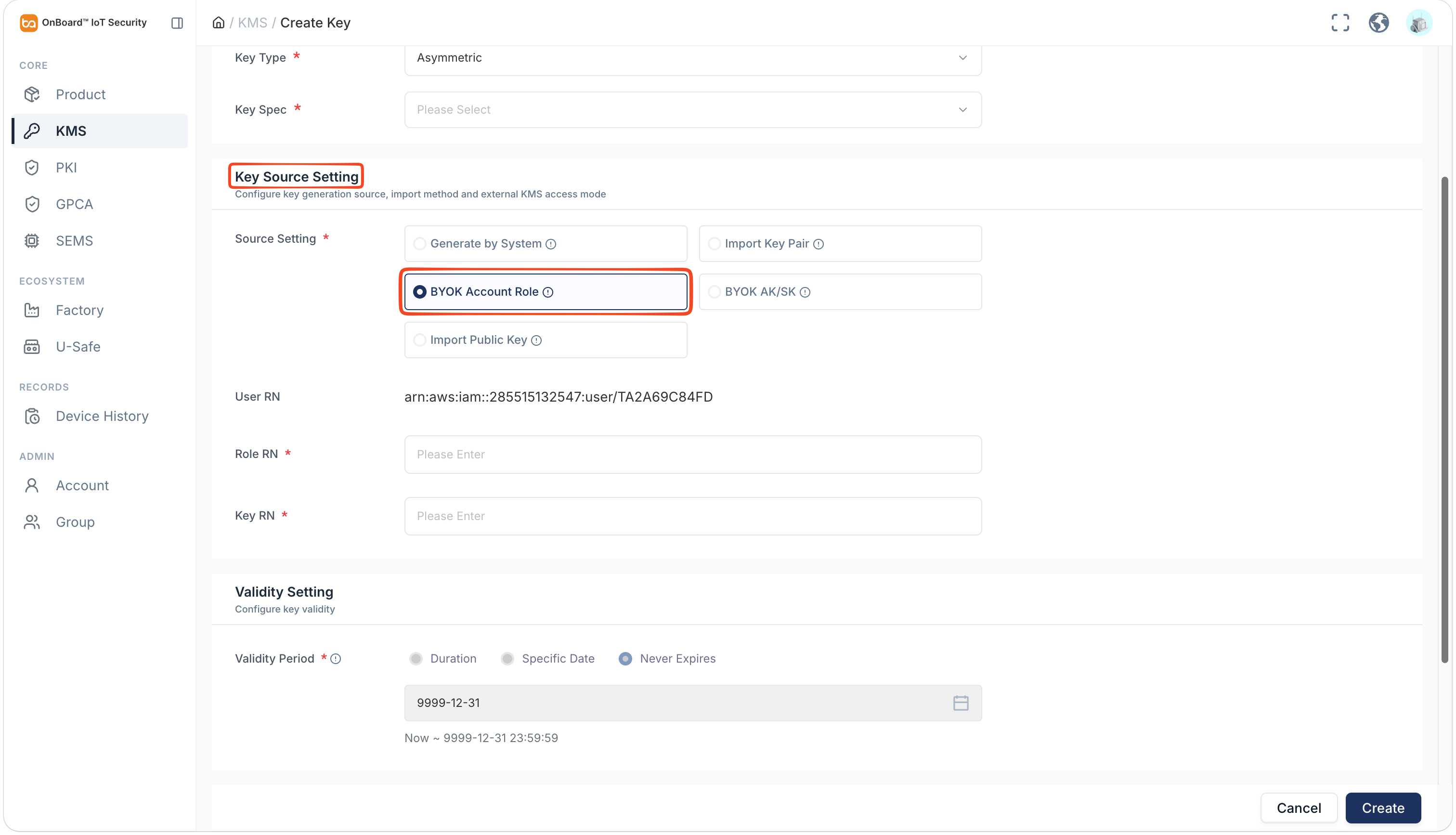
Description of Account Role information:
| Information | Mandatory | Description |
|---|---|---|
| User RN | No | Uniquely identifies a user in AWS IAM (such as an administrator or developer), used for permission assignment and resource access control. |
| Role RN | Yes | Uniquely identifies a role in AWS IAM, used for temporary permission assignment (such as cross-account access for EC2 instances or Lambda functions). |
| Key RN | Yes | Uniquely identifies an encryption key in AWS KMS, used for data encryption and decryption. |
Access external keys from third-party KMS using Access Key and Secret Key credentials.
In the Key Source Setting section, select BYOK AK/SK, and then enter the key-related information.
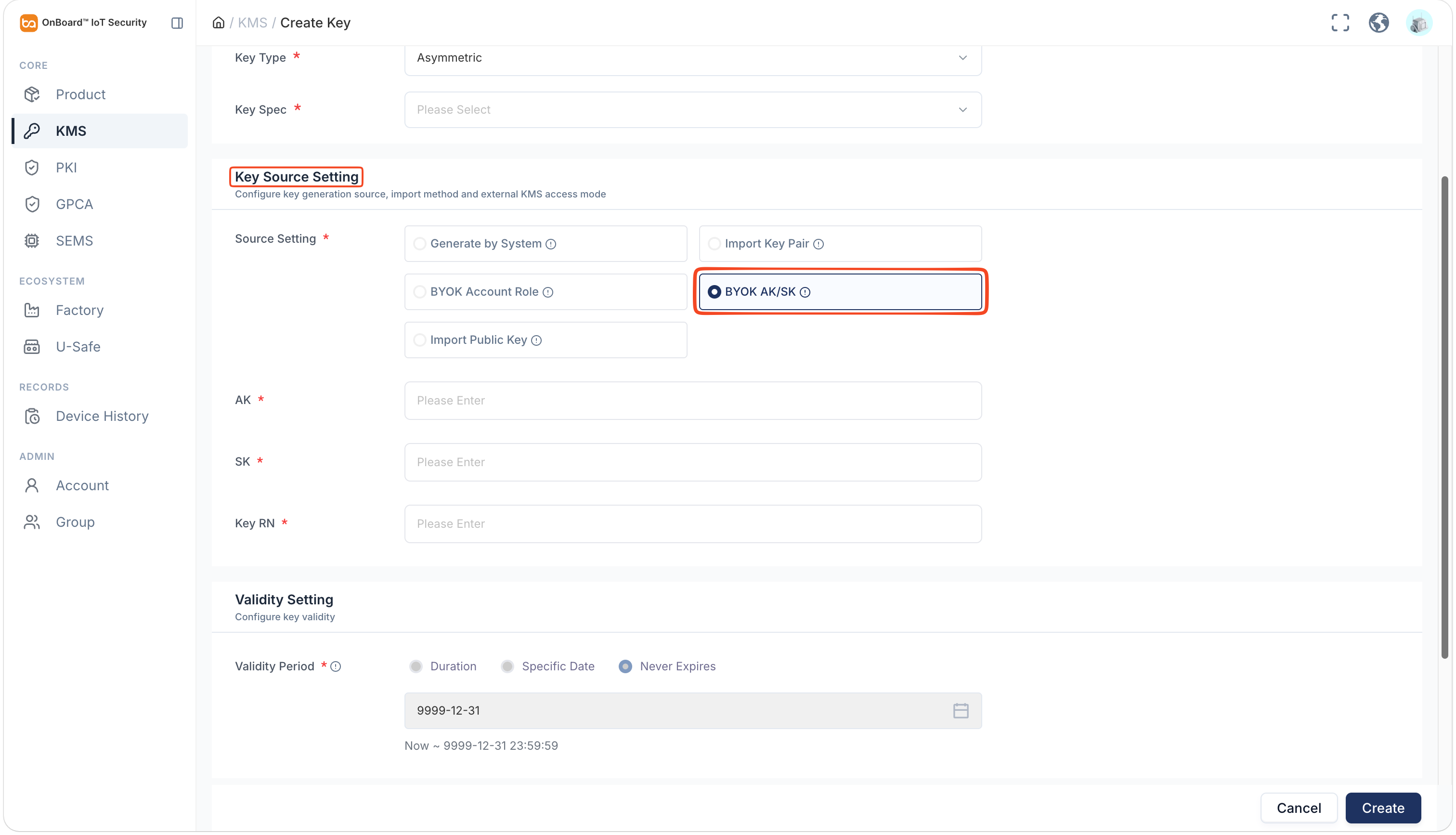
Description of AK/SK information:
| Information | Mandatory | Description |
|---|---|---|
| AK | Yes | AK (Access Key ID):
|
| SK | Yes | SK (Secret Access Key):
|
| Key RN | Yes | ARN (Amazon Resource Name): uniquely identifies an encryption key in AWS KMS, used for data encryption and decryption. |
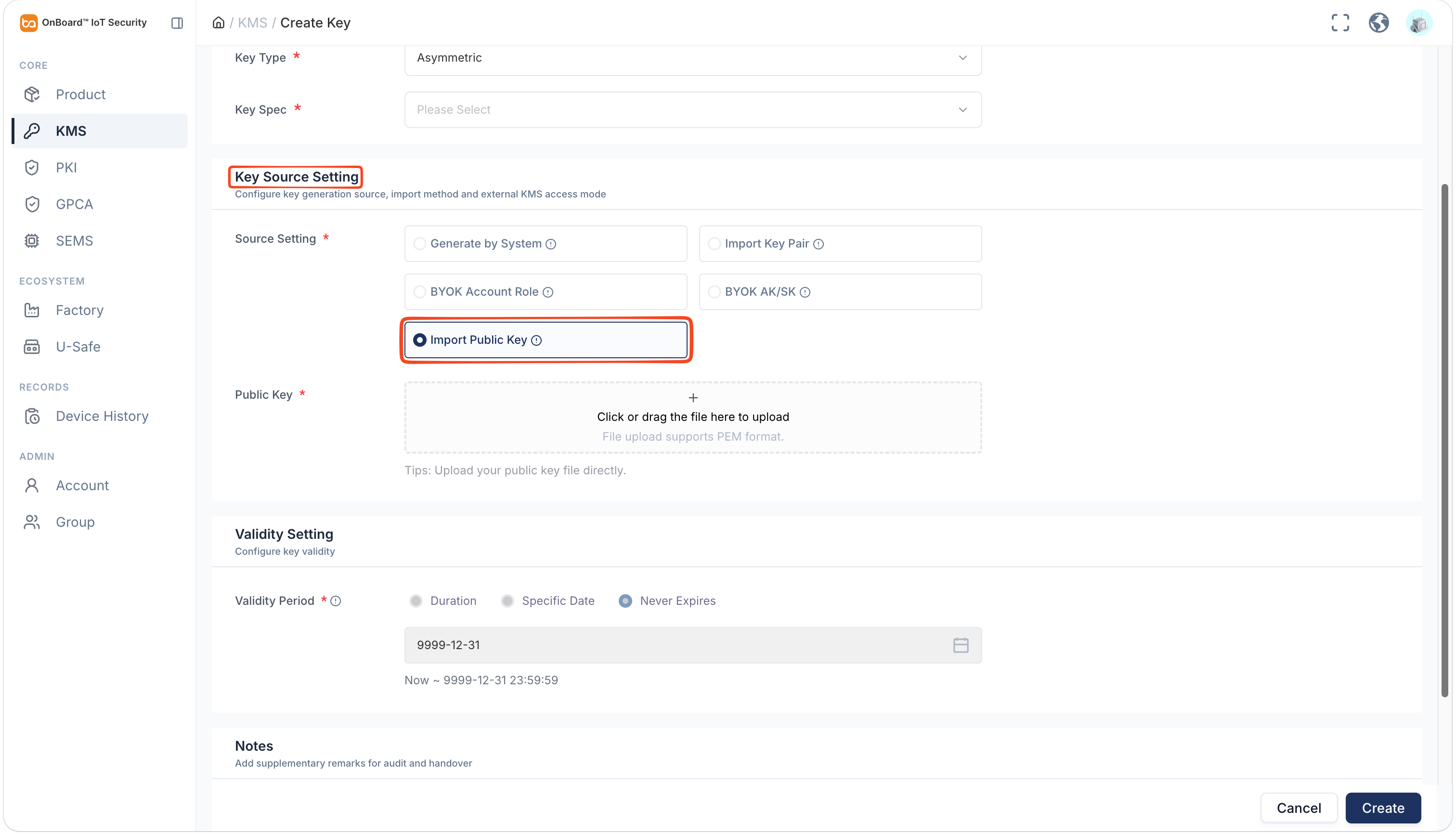
Step three: Configure the validity
In the Validity Setting section, you can choose Duration, Specific Date, or Never Expires to set the validity period as needed.
Step four: Add the notes
In the Notes section, you can provide additional information related to the key, such as special requirements and important notes.
Step five: Complete the creation
After verifying that the configuration is correct, click Create. Once the key is successfully created, it can be checked on the KMS page.
By default, the key creator is set as the Admin. To change the Admin, click the Options  icon for the Admin and select Transfer Admin on the Member tab, then choose the new Admin and click Confirm.

 Download User Manual